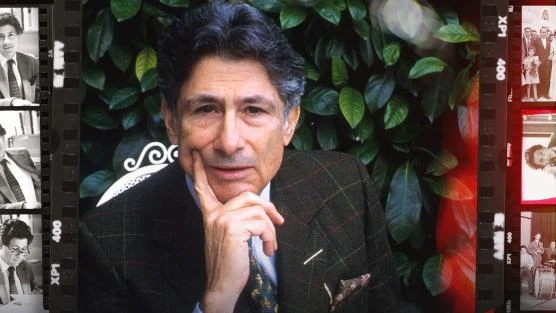
Twenty-three years after his death, the Palestinian-American scholar, musician and intellectual Edward Said tells the untold history of Palestine in his own words. Made with full access to the Said family and estate, Maiken Baird’s documentary draws on never-before-seen home movies, rare television appearances and lectures to trace seven decades, from a childhood in Jerusalem to his death in New York, and asks who has the right to tell their own story.
Twenty-three years after his death, the renowned Palestinian-American scholar, musician and intellectual Edward Said tells the untold history of Palestine in his own words. The first documentary made with full access to the Said family and estate, this all-archival portrait draws on hundreds of hours of lectures, television appearances, interviews and debates, alongside never-before-seen 8mm home movies shot by his father. They capture a childhood in Jerusalem before the Nakba of 1948, the family’s years in Egypt and Lebanon, and his arrival in America as a teenager who would spend his entire adult life in exile.
Said became one of the most influential public intellectuals of the 20th century. His 1978 book ‘Orientalism’ dismantled Western stereotypes of Arab culture and identity and became a foundational text of postcolonial studies, while ‘The Question of Palestine’ brought the Palestinian experience to English-language readers. A classically trained pianist and music critic, he was as eloquent at the keyboard as he was on television, and a series of BBC documentaries gave him a broader canvas to tell his own story and that of his people. Spanning seven decades, Maiken Baird’s film weaves together the personal and the political and asks who has the right to tell their own story.
Said became one of the most influential public intellectuals of the 20th century. His 1978 book ‘Orientalism’ dismantled Western stereotypes of Arab culture and identity and became a foundational text of postcolonial studies, while ‘The Question of Palestine’ brought the Palestinian experience to English-language readers. A classically trained pianist and music critic, he was as eloquent at the keyboard as he was on television, and a series of BBC documentaries gave him a broader canvas to tell his own story and that of his people. Spanning seven decades, Maiken Baird’s film weaves together the personal and the political and asks who has the right to tell their own story.