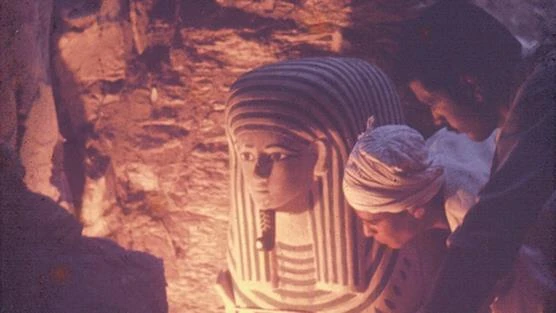
Upper Egypt, 1881. When precious antiquities begin turning up for sale, the authorities in Cairo send a young official upriver to Thebes to find the secret tomb they came from. Meanwhile, the chief of a mountain tribe dies, and his sons learn that for decades their people have lived by plundering the tombs of the pharaohs. Torn between loyalty to their family and their own conscience, they must decide whether to keep the secret or betray it.
Based on the real discovery of a cache of royal mummies at Deir el-Bahari in 1881, the film opens in Cairo, where the antiquities authorities are alarmed by treasures appearing on the market from a tomb no archaeologist has found. A dedicated young member of their committee is sent upriver to Thebes to trace it. Meanwhile, Salim, chief of the Hurabat, a mountain tribe near Thebes, dies, and the secret that has sustained his people for decades passes to his sons. Wannis and his brother are appalled to discover that the tribe has been living on the riches of the dead. Now they must choose: obey their late father’s wishes and loot the tombs, or reveal their elders’ secret and be cast out by their family and tribe.
Shot in classical Arabic, Shadi Abdel Salam’s only feature unfolds in long takes and slow, deliberate editing that underscore the weight of the choice his characters face, while Mario Nascimbene’s haunting score plays beneath its dreamlike images with a sense of fateful unease. Made with the encouragement of Roberto Rossellini, it is widely regarded as one of the greatest Egyptian films ever made: a richly realised meditation on cultural heritage, the past and the meaning of death. Long seen only in faded prints, it returns restored from its original camera negatives.
Shot in classical Arabic, Shadi Abdel Salam’s only feature unfolds in long takes and slow, deliberate editing that underscore the weight of the choice his characters face, while Mario Nascimbene’s haunting score plays beneath its dreamlike images with a sense of fateful unease. Made with the encouragement of Roberto Rossellini, it is widely regarded as one of the greatest Egyptian films ever made: a richly realised meditation on cultural heritage, the past and the meaning of death. Long seen only in faded prints, it returns restored from its original camera negatives.